Free tool · Purchasing
A purchase order the receiving bay can actually match.
Fill it in below and print it. It carries the fields the free templates leave off: numbered lines, a unit of measure on every one, and the instruction that puts your order number on the supplier’s packing slip. Those three are what decide whether the delivery can be received without a phone call.
In short
- A purchase order is an offer to buy. Under U.C.C. § 2-206 the supplier can accept it by shipping, without signing anything.
- The fields that break receiving are the boring ones: the order number on their paperwork, a unit of measure on every line, and stable line numbers for part deliveries.
- Ship-to is not bill-to. Filling it from the letterhead is how a pallet arrives at an office with no bay.
- For $500 or more, U.C.C. § 2-201 wants a signed writing before a sale of goods is enforceable.
Purchase order
Saved in this browser as you type. Nothing is uploaded.
Purchase Order
This number must appear on all packing slips, cartons, invoices and correspondence
Buyer
Who is placing and paying for the order.
Vendor
Who is supplying the goods.
Ship to
Where the goods physically arrive. Often not the buyer's address.
Freight terms
| Ln | Item / part no. | Description | Qty | UOM | Unit price | Amount | |
|---|---|---|---|---|---|---|---|
| 01 | |||||||
| 02 | |||||||
| 03 | |||||||
| 04 |
Notes and special instructions
- Subtotal
- 0.00
- Tax
- 0.00
- Shipping
- Total
- 0.00
No line has both a quantity and a price yet.
Conditions
- 1. Acceptance of this order, by acknowledgement or by shipment, is acceptance of these conditions unless the seller objects in writing before shipping.
- 2. Show the purchase order number and the line number on every packing slip, carton label, invoice and delivery note.
- 3. Quantities are in the unit of measure stated on each line. Do not substitute a different pack size without written agreement.
- 4. Goods are subject to inspection and count on arrival, and may be rejected after payment if a defect could not reasonably have been found on delivery.
- 5. Deliver by the required-by date. Notify the buyer in writing as soon as a delay is known rather than on the day.
- 6. Prices are as stated. Any charge not on this order requires written agreement before it is incurred.
Signature
What the document is
An offer, which a supplier can accept by loading a truck
A purchase order is not a contract at the moment you send it. It is an offer to buy, and it becomes a contract when the supplier accepts. What surprises people is how little acceptance takes. U.C.C. § 2-206(1)(b) says an order to buy goods for prompt shipment invites acceptance either by a prompt promise to ship or by the shipment itself. No signature, no acknowledgement, no reply. A supplier who reads your order and sends the goods has agreed to it.
That cuts both ways, and the direction that costs money is the one where their acknowledgement comes back carrying terms yours did not. § 2-207 is the provision every purchasing course calls the battle of the forms. Between merchants, additional terms in the supplier’s acceptance can become part of the contract unless your order expressly limits acceptance to its own terms, the addition materially alters the deal, or you object in reasonable time. The practical reading is unglamorous: read acknowledgements instead of filing them, and reply in writing when one says something new.
For anything of size, get it in writing at all. § 2-201 makes a contract for the sale of goods priced at $500 or more unenforceable without a writing signed by the party you are trying to hold to it. Between merchants there is a second route: a written confirmation binds the party who receives it unless they object in writing within ten days.
One honest caveat before any of that is useful. The Uniform Commercial Code is not federal law. It is a model code adopted state by state, with variations, and Louisiana has never adopted Article 2 at all. Section numbers are near-universal and the wording is usually identical, but the version that governs your order is your state’s, and your contract with the supplier can displace much of it.
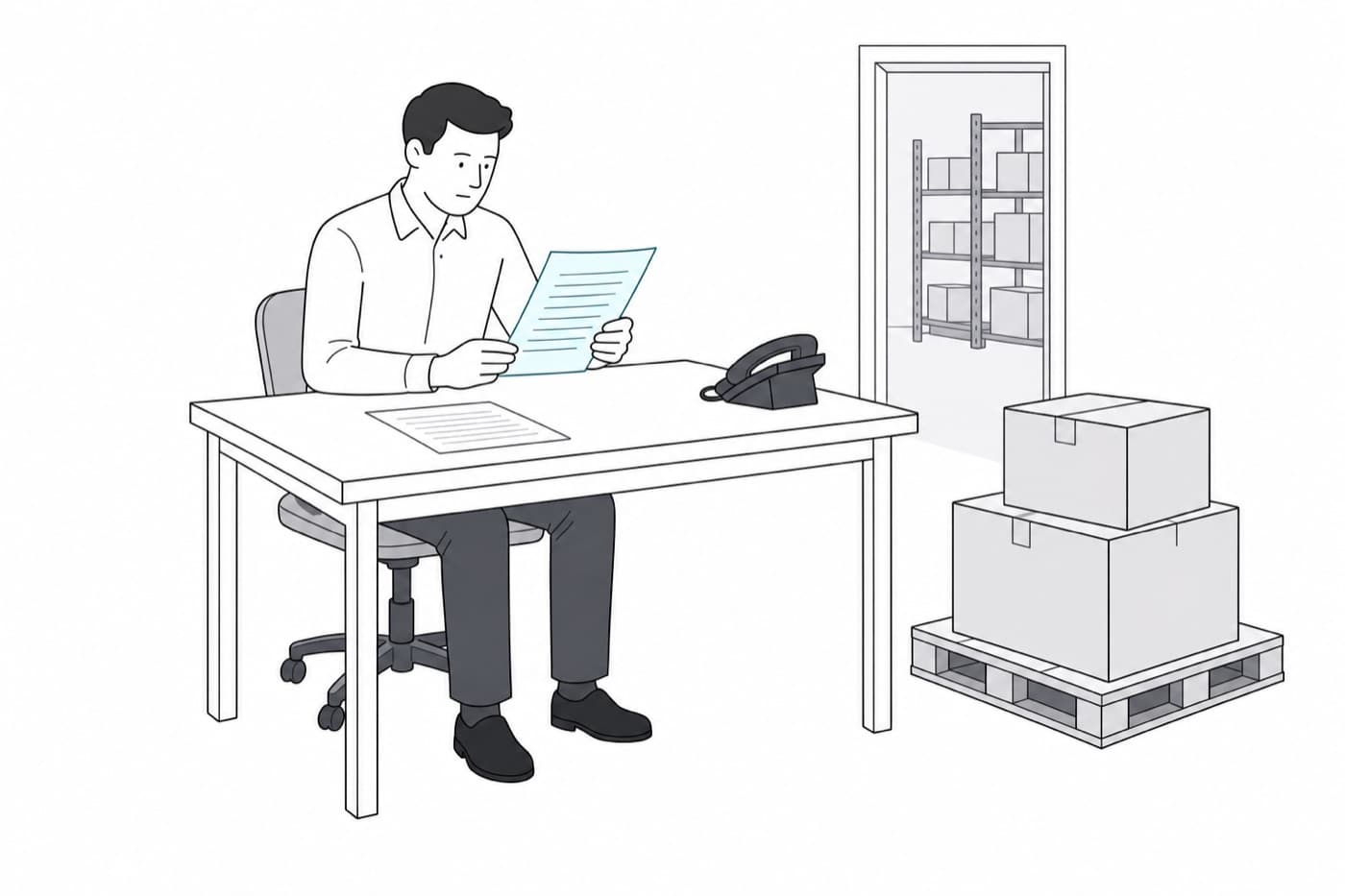
The five fields that decide whether it can be received
We build receiving software, so what we see is not the order being written. It is somebody at a bay an hour later trying to work out what arrived and whether it matches. These five fields are what that person needs, and they are exactly the ones the free templates leave off.
- 01
The order number, and the instruction to repeat it
Not on your copy, on theirs. The number is only useful once it is printed on the supplier’s packing slip and on the carton labels, which is why the sheet above carries the standard instruction saying so. An order number that never leaves your building identifies nothing at the point where identification is needed, and we set out every document it has to appear on separately.
- 02
A line number on every line, kept stable
Deliveries arrive in parts far more often than purchasing expects. Matching a part delivery means matching line by line, and that only works if line 4 is still line 4 after the order was revised. Renumbering lines between revisions is quietly one of the most disruptive things a buyer can do.
- 03
A unit of measure on every line
A quantity with no unit is not a quantity. Ordering 12 and receiving 12 cases of 12 is the most common quantity dispute there is, and it is not caused by anyone being careless: it is caused by a document that never said which. We wrote about how a unit of measure mismatch plays out separately, because it is rarely noticed on the day.
- 04
A ship-to address that is separate from the buyer
The buyer's address is on the letterhead, so a single-address template gets filled in once and the goods go to the office. Any company with a separate works, a third-party warehouse or a customer drop-ship needs these as two fields, and needs them printed side by side so the difference is visible on paper.
- 05
A required-by date, rather than a lead time
A lead time is a promise about a duration and a date is a promise about a moment. Only one of them can be checked on the day, and only one of them tells the receiving end whether a delivery has arrived early enough to matter.
Which document says what
Four documents describe the same delivery and people use the names interchangeably, which is where a good deal of the confusion at month end comes from. They are issued by different parties, at different moments, and they disagree far more often than anybody expects.
| Document | Issued by | When | What it asserts |
|---|---|---|---|
| Purchase order | The buyer | Before anything ships | What we want, at what price |
| Packing slip | The supplier | In the box | What we say we put in |
| Goods received note | The buyer | At the bay | What we actually counted |
| Invoice | The supplier | After shipping | What we are charging you for |
The three that get mixed up most are the purchase order, the packing slip and the invoice, which we pulled apart document by document. Comparing the first, the third and the fourth is three-way matching, and it is the control that catches being invoiced for twelve when ten arrived. It only works if all three carry the same order number and the same line numbers, which is the entire argument for filling those fields in properly at the top of the process rather than reconstructing them at the bottom.
Your right to count it, and your duty to say so
Counting a delivery is often treated as housekeeping that can wait until somebody has time. The code treats it as the moment your position is fixed.
§ 2-513 gives a buyer the right to inspect goods before payment or acceptance, at any reasonable place and time. § 2-606 then says acceptance happens not only when you say the goods conform, but when you fail to reject them after a reasonable opportunity to inspect, or do anything inconsistent with the seller still owning them. Putting a pallet into stock is that second thing.
And § 2-607(3)(a) is the one that bites: a buyer who has accepted must notify the seller of any breach within a reasonable time after discovering or having reason to discover it, or be barred from any remedy. Not a reduced remedy. Barred.
Which is why the count at the bay, and a record of it with a date on it, is worth more than its five minutes suggest. It is the evidence that fixes what arrived while anybody can still do something about it.
Numbering orders so two of them are never the same
Use one sequential series with a short fixed prefix, and put no meaning in the number. Schemes that encode the year, the department or the supplier read as organised for about eighteen months, and then the year rolls over, a department is renamed, or two people issue the same number on the same afternoon because both were working from the supplier’s code.
A duplicate order number is the expensive failure, because two different orders then look like one order to everybody downstream: the supplier, your receiving bay, and your own accounts payable. A plain incrementing series is dull and it never collides.
Where an order is revised rather than replaced, keep the number and increment a revision field, which the form above provides. Reissuing a changed order under a new number leaves the supplier holding two documents and guessing which one is live.
What this generator does, and what it does not
It runs entirely in your browser
Everything you type stays on your machine. The draft is saved in this browser's local storage so a reload does not lose your work, and Clear removes it. There is no account, no upload and no server that could hold a copy.
It does the arithmetic to the cent
Line amounts, subtotal, tax and total are computed as you type, each line rounded once so the printed column adds up to the printed total. Amounts are read the way people type them, including currency symbols and thousands separators.
It is not legal advice
The conditions printed on the sheet are ordinary commercial ones, not terms drafted for your business. A purchase order is a contract document and its terms matter. Where the money or the risk is significant, have your own terms written and referenced on the order.
It does not track anything
It prints one order. It does not number them for you, remember what you sent, tell you what arrived, or match a delivery against it. Those are different jobs, and the honest thing is to say so rather than imply a form can do them.
Questions
- Is this purchase order template free?
- Yes. Fill it in on the page, then print it or save it as a PDF. There is no account, no email address, no watermark and no download step. Nothing you type is transmitted anywhere: the draft is held in your own browser so a reload does not cost you the typing, and the Clear button removes it.
- What is a purchase order?
- A document a buyer issues to a supplier that states exactly what is being ordered, in what quantity and unit, at what price, delivered where and by when. Legally it is an offer to buy. Under U.C.C. § 2-206 an order for prompt shipment invites acceptance either by a promise to ship or by the shipment itself, so a supplier who simply sends the goods has accepted your terms without ever signing anything.
- Is a purchase order a legally binding contract?
- Not on its own. It is an offer, and it becomes a contract when the supplier accepts it, which they can do by acknowledging it or by shipping. Once that happens the purchase order is normally the document that defines what was agreed. For orders of $500 or more, U.C.C. § 2-201 requires a signed writing before a contract for the sale of goods is enforceable, which is one reason to issue a written order rather than a phone call and an email.
- What must be on a purchase order?
- No statute lists the fields. What the trade needs is an order number, the date, the buyer, the supplier, a separate ship-to address, one numbered line per item with a description, a quantity, a unit of measure and a price, the required-by date, the payment and freight terms, and an authorising name. The unit of measure and the line numbers are the two most often left off, and they are the two the receiving end cannot work without.
- What is the difference between a purchase order and an invoice?
- Direction and timing. The buyer issues the purchase order first, saying what they want. The supplier issues the invoice afterwards, asking to be paid for what they sent. Between the two sits the packing slip, which says what was actually in the box. Comparing all three is called three-way matching, and it is the only way to find out that you were invoiced for twelve and delivered ten.
- Why does the purchase order number need to be on the packing slip?
- Because without it the person receiving the delivery cannot tell which order it belongs to. This is the single most common cause of a delivery sitting on the floor for a day: the cartons arrive, the packing slip names the supplier and lists the items, and nobody in receiving knows which of the four open orders with that supplier it satisfies. The order form above carries the standard instruction to show the number on all packing slips, cartons, invoices and correspondence, and it is worth enforcing.
- Can a supplier change the terms on my purchase order?
- They can try, and U.C.C. § 2-207 governs what happens next. Between merchants, additional terms in the supplier's acknowledgement can become part of the contract unless your order expressly limits acceptance to its own terms, the new terms materially alter the deal, or you object within a reasonable time. In practice: read the acknowledgement rather than filing it, and object in writing when it says something your order did not.
- Do I have to inspect goods before I pay?
- You have the right to. U.C.C. § 2-513 gives a buyer the right to inspect goods before payment or acceptance, at a reasonable place and time. The corresponding duty is in § 2-607(3)(a): once you have accepted, you must notify the seller of any breach within a reasonable time of discovering it or you are barred from a remedy. That is why counting a delivery on arrival is not administrative tidiness but the thing that preserves your position.
- How should I number purchase orders?
- Sequentially, from a single series, with no meaning encoded in the number. Numbers that carry a year, a department or a supplier code look organised until the year rolls over, the department is renamed, or two people issue the same number on the same afternoon. A plain incrementing series with a short prefix is boring and never collides, and a collision is the failure that is genuinely expensive because two different orders then look like one.
- Does a purchase order need a signature?
- Not for most trade orders, and many companies send them unsigned. Add one where the amount is large, where the supplier is new, or where anyone might later argue about authority to commit the spend. Under § 2-201 the signature that matters for enforceability is the one belonging to the party you are trying to enforce against, so your own signature on your own order is about internal authorisation rather than about binding the supplier.
Sources
- 01U.C.C. § 2-206: Offer and Acceptance in Formation of Contract · Legal Information Institute, Cornell Law SchoolAn order to buy goods for prompt shipment invites acceptance either by a prompt promise to ship or by the shipment itself. This is why a supplier who simply ships has accepted your order.
- 02U.C.C. § 2-207: Additional Terms in Acceptance or Confirmation · Legal Information Institute, Cornell Law SchoolThe battle of the forms. What happens when the supplier's acknowledgement carries terms your order did not.
- 03U.C.C. § 2-201: Formal Requirements; Statute of Frauds · Legal Information Institute, Cornell Law SchoolA contract for the sale of goods for $500 or more needs a signed writing to be enforceable, with a ten day objection window on a written confirmation between merchants.
- 04U.C.C. § 2-513: Buyer's Right to Inspection of Goods · Legal Information Institute, Cornell Law SchoolThe right to inspect before payment or acceptance, at a reasonable place and time.
- 05U.C.C. § 2-607: Effect of Acceptance; Notice of Breach · Legal Information Institute, Cornell Law SchoolSubsection (3)(a): a buyer who has accepted goods must notify the seller of a breach within a reasonable time after discovering it, or be barred from any remedy.
- 06U.C.C. § 2-606: What Constitutes Acceptance of Goods · Legal Information Institute, Cornell Law SchoolAcceptance happens by saying the goods conform, by failing to reject after a reasonable chance to inspect, or by acting inconsistently with the seller's ownership.
This describes how the rules generally work in the United States and links to the primary sources so you can read them yourself. It is not legal advice, and your contract with a supplier or carrier can change any of it. For money that matters, ask a lawyer.
A purchase order is a promise about what will arrive. Finding out whether it did is a separate job, and it is the one that gets skipped. DockCount reads the packing slip from a phone at the bay, checks it against the order line by line, and keeps the photographs. Free for 25 deliveries a month.