Receiving 101 · Purchasing
A PO number is only worth what it is repeated on.
It is the buyer’s reference for one order. That much is a definition. The part that matters is what happens to it afterwards: it has to appear on the supplier’s acknowledgement, on the packing slip in the box, on the carton labels and on the invoice, and every place it fails to appear is a place somebody has to work out by hand what a delivery belongs to.
In short
- The buyer issues it, always. A supplier who invents one has created a reference nobody can match.
- Its job is to be repeated. A number that never leaves your building identifies nothing at the point where identification is needed.
- Number sequentially with no meaning in the digits. Duplicates are the failure with no clean recovery.
- Federal purchasing writes the rule down: FAR 4.1601 requires the identifier to be unique Governmentwide for at least twenty years.
What it is, in one paragraph
A purchase order number is the reference a buyer assigns to a single purchase order when they issue it. It identifies the order rather than describing it: no part of it needs to mean anything, and the less it means the better it works. Everything that happens afterwards: the supplier’s acknowledgement, the goods arriving, the invoice, the payment, and any argument about any of them: is tied together by that one string.
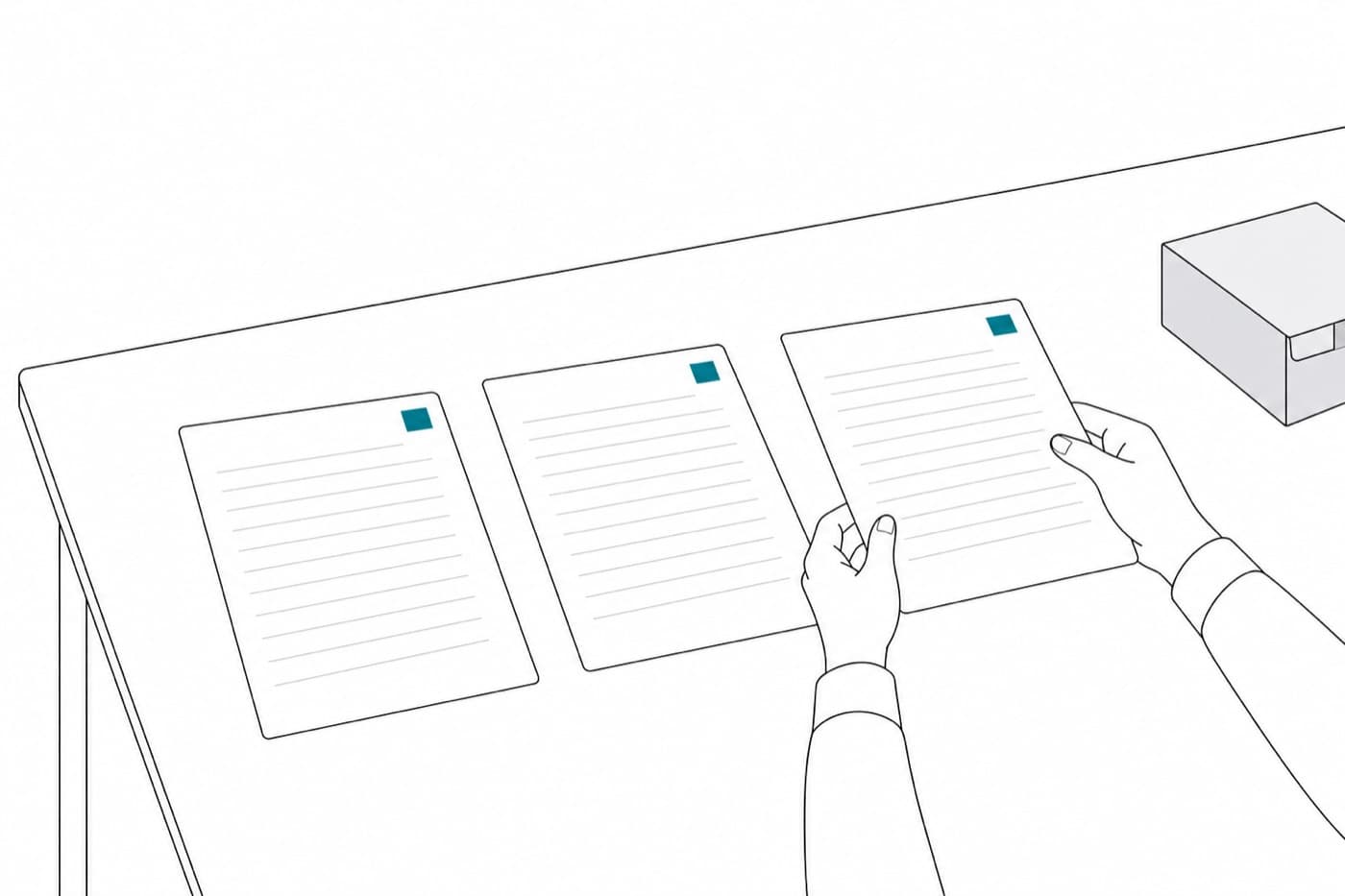
Where it has to appear
Nine documents describe one order between them, issued by both sides at different moments. The order number is what makes them one set rather than nine.
| Document | Issued by | What the number does there |
|---|---|---|
| Purchase order | Buyer | It is the number. Everything downstream quotes this one. |
| Order acknowledgement | Supplier | Confirms which order they accepted. Read it: this is where changed terms arrive. |
| Advance shipping notice | Supplier | Lets the bay know what is coming and against which order, before it arrives. |
| Packing slip | Supplier | The one that matters most. Without it the receiver cannot tell which open order the cartons satisfy. |
| Carton and pallet labels | Supplier | Readable without opening anything, which is how a mixed delivery gets split correctly. |
| Bill of lading | Shipper | In the customer order section, so the freight can be tied to the order it belongs to. |
| Goods received note | Buyer | Records what was actually counted, against the order it was counted for. |
| Invoice | Supplier | Without it, the invoice cannot be matched and in most companies is simply not paid. |
| Remittance advice | Buyer | Tells the supplier's accounts receivable what the payment settles. |
What the supplier prints is a requirement you set, not a favour they do. ISO 9001:2015 clause 8.4.3 puts it in the standard’s own terms: an organisation has to communicate its requirements to external providers before relying on them. So the instruction goes on the order itself, which is where the generator on this site prints it, in the place the trade puts it: show this number on all packing slips, cartons, invoices and correspondence.
What a missing number costs, at the bay
We build receiving software, so the version of this problem we see is not the one purchasing sees. It looks like this.
Three pallets arrive from a supplier you buy from constantly. The packing slip names the supplier and lists eleven items. There are four orders open with that supplier and two of them include some of those items. The person at the bay now has a choice between three bad options: sign for it and work it out later, hold the driver while they phone purchasing, or match it by eye to whichever order looks closest.
The third is the one that actually happens, and it is the worst, because it is silent. A delivery received against the wrong order closes a line that is still outstanding and leaves a line open that has already been delivered. Nothing looks wrong. The shortage surfaces weeks later on the order nobody was watching, by which point the carrier’s claim window may have closed and the supplier’s records say the goods were signed for.
All of that is downstream of one field on one document. It is why the number is worth more attention than a reference number seems to deserve.
How to number them, and what the government does
The advice is dull: one sequential series, a short fixed prefix, no meaning in the digits. It is worth saying why, because the tempting alternative looks better and is worse.
Encoding the year, the department or the supplier into the number makes it readable at a glance, and buys a problem on the day the year rolls over, the department is renamed, or two people generate the same number in the same afternoon because both started from the same supplier code. A duplicate is the failure with no clean recovery: two different orders look like one order to your supplier, your receiving bay and your accounts payable simultaneously, and every one of them resolves it differently.
If you want to see the idea taken seriously, look at what US federal purchasing does. FAR 4.1603 specifies a procurement instrument identifier of thirteen to seventeen characters: the issuing office’s activity address code in positions 1 to 6, the last two digits of the fiscal year in 7 and 8, a single letter for the instrument type in position 9, and a serial number of four to eight characters after that.
And FAR 4.1601 sets the requirement that the structure exists to serve: each identifier must be unique Governmentwide, and remain unique for at least twenty years from the date of award.
You almost certainly do not need seventeen characters. What is worth borrowing is the priority: the scheme is built around never colliding, and the readability is a consequence rather than the goal.
The numbers people confuse it with
Sales order number
The supplier's own reference for the same transaction, from their sequence. Useful when you call them and useless for matching anything on your side. Their acknowledgement should carry both.
Invoice number
The supplier's reference for a request for payment. Points the other way down the process. A good invoice carries its own number and your order number.
Release or call-off number
On a blanket order, the order number identifies the agreement and the release identifies one delivery against it. Both belong on the paperwork; the order number alone cannot say which delivery this is.
Job, project or works number
Yours, and internal. It says what the goods are for rather than what was ordered. Worth printing on the order as a second reference, never in place of the order number.
When a delivery arrives with no order number on it
It happens, and the instinct is to work it out. Resist the specific version of that instinct which matches by supplier and item, because that is the one that creates the silent error described above.
- 01
Note it on the delivery receipt before signing
Write that the shipment carries no order reference. A signature with nothing noted is evidence the goods arrived in apparent good order, and you are about to be unable to say which order they were.
- 02
Photograph the paperwork and the cartons
Including any labels. This is thirty seconds and it is the only record that will exist of what actually turned up.
- 03
Hold the goods rather than putting them away
Once a pallet is in stock it has been accepted in practical terms and, under U.C.C. § 2-606, arguably in law: acting inconsistently with the seller's ownership is one of the ways acceptance happens.
- 04
Ask the supplier which order it is, in writing
Their answer is what you receive against, and the written trail is what protects you if the answer turns out to be wrong.
The document that should have carried the number is the packing slip, and the generator here puts the order number in its masthead next to the slip’s own. If you are the one sending goods out, that field is the single cheapest thing you can do for the person receiving them.
Questions
- What is a PO number?
- A purchase order number is the buyer's own reference for a single order, printed on the purchase order and then repeated on every document that follows it: the supplier's acknowledgement, the packing slip in the box, the carton labels, the bill of lading, the invoice and the remittance. It identifies the order rather than describing it, which is why it has to be unique and why it has to travel.
- Who issues the PO number, the buyer or the supplier?
- Always the buyer. The number comes from the buyer's own sequence and means nothing in the supplier's system except as a reference to quote back. A supplier who invents one because none was given has created a number the buyer cannot match anything against, which is worse than leaving the field blank.
- What does a PO number look like?
- There is no standard format for commercial trade. Most are a short fixed prefix and an incrementing number, like PO-10421. Federal purchasing is the exception and has a real specification: under FAR 4.1603 a procurement instrument identifier is thirteen to seventeen characters, with the issuing office's activity address code first, then the fiscal year, then a letter for the instrument type, then a serial number.
- How should I number purchase orders?
- One sequential series, a short fixed prefix, and no meaning encoded in the digits. Schemes that bury the year, the department or the supplier in the number read as organised until the year rolls over or a department is renamed, and they create the one failure that genuinely costs money: two different orders with the same number, which look like one order to the supplier, your receiving bay and your accounts payable at the same time.
- Is the PO number the same as the invoice number?
- No, and they point in opposite directions. The PO number is issued by the buyer and identifies what was ordered. The invoice number is issued by the supplier and identifies a request for payment. A good invoice carries both: its own number, and the buyer's PO number so the buyer can match it. An invoice with no PO number on it is the most common reason a payment run skips it.
- Why does my supplier keep asking for a PO number?
- Usually because their accounts receivable cannot get an invoice paid without it. Many buyers operate a no-PO-no-pay rule, which means an invoice arriving with no order number is rejected on receipt rather than queried, so the supplier is asking for the thing that lets them be paid at all.
- What is the difference between a PO number and a release number?
- On a blanket order, one agreement covering many deliveries over a period, the PO number identifies the agreement and a release number identifies each call-off against it. Both need to appear on the delivery paperwork, because the order number alone cannot tell a receiver which of eleven scheduled deliveries this pallet is.
- What do I do when a delivery arrives with no PO number on the paperwork?
- Do not guess it, and do not sign a clean receipt for goods you cannot identify. Note on the delivery receipt that the shipment carries no order reference, take a photograph of the paperwork and the cartons, and hold the goods rather than putting them into stock. Matching by supplier name and item is how a delivery gets received against the wrong order, which is worse than an unmatched one because it silently closes a line that is still outstanding.
- Does a PO number have to be unique?
- For any practical purpose, yes. Nothing in commercial law imposes it, but every system that consumes the number assumes it, and a duplicate is the failure with no clean recovery. Federal purchasing writes the rule down explicitly: FAR 4.1601 requires a procurement instrument identifier to be unique Governmentwide and to stay unique for at least twenty years from award.
Sources
- 01FAR 4.1601: Policy (unique procurement instrument identifiers) · Federal Acquisition Regulation, acquisition.govRequires each PIID identifying a solicitation or contract action to be unique Governmentwide, and to remain so for at least 20 years from the date of contract award.
- 02FAR 4.1603: Procedures · Federal Acquisition Regulation, acquisition.govThe structure: thirteen to seventeen characters, the issuing office's activity address code in positions 1 to 6, the fiscal year in 7 and 8, a single-letter instrument type code in position 9, and a serial number of four to eight characters after it.
- 03U.C.C. § 2-201: Formal Requirements; Statute of Frauds · Legal Information Institute, Cornell Law SchoolA contract for the sale of goods for $500 or more needs a writing signed by the party against whom enforcement is sought. The order is that writing, and its number is how it is identified afterwards.
- 04U.C.C. § 2-207: Additional Terms in Acceptance or Confirmation · Legal Information Institute, Cornell Law SchoolWhy the acknowledgement that comes back quoting your order number is worth reading rather than filing: additional terms in it can become part of the contract.
- 05ISO 9001:2015, clause 8.4.3: information for external providers · International Organization for StandardizationRequires an organisation to communicate its requirements to external providers before telling them to them. What must appear on the supplier's paperwork is one of those requirements, and it belongs on the order.
This describes how the rules generally work in the United States and links to the primary sources so you can read them yourself. It is not legal advice, and your contract with a supplier or carrier can change any of it. For money that matters, ask a lawyer.
Every one of those nine documents is a claim about the same delivery, and the order number is the only thing holding them together. DockCount reads the packing slip at the bay, finds the order it belongs to, and checks it line by line. Free for 25 deliveries a month.