Free tool · Shipping documents
The packing slip that shows what is missing.
Fill it in below and print it. It has two quantity columns rather than one, ordered and shipped, with the balance worked out beside them. That is the whole difference between a packing slip and a list of contents, and almost no free template makes it.
In short
- One quantity column makes the document a list of contents. Two makes a shortage something the supplier declared rather than something the buyer found.
- No prices. A packing slip is read by the carrier, the warehouse and sometimes a reseller's customer.
- The purchase order number is the field that decides whether the delivery can be identified at all.
- Count before signing. Under U.C.C. § 2-607(3)(a) a buyer who accepts and then fails to give notice in reasonable time is barred from a remedy.
Packing slip
Saved in this browser as you type. Nothing is uploaded.
Packing Slip
No prices. Count the goods against this slip before signing for them
Ship from
Who packed and dispatched the goods.
Sold to
Who placed the order and will be invoiced.
Ship to
Where this shipment is being delivered.
| Ln | Item / part no. | Description | UOM | Ordered | Shipped | To follow | Status | |
|---|---|---|---|---|---|---|---|---|
| 01 | ||||||||
| 02 | ||||||||
| 03 | ||||||||
| 04 |
Notes
- Lines in this shipment
- 0
- Units in this shipment
- 0
- Still to follow
- 0
- Lines not matching the order
- 0
Every line with quantities on it matches what was ordered.
Received by
Count the goods before signing. Write any shortage, damage or difference here, on both copies, before the driver leaves. A signature with nothing noted is evidence the goods arrived in apparent good order.
Print name
Date
Time
Exceptions noted on receipt
Signature
The column almost nobody includes
A shortage should be declared, not discovered
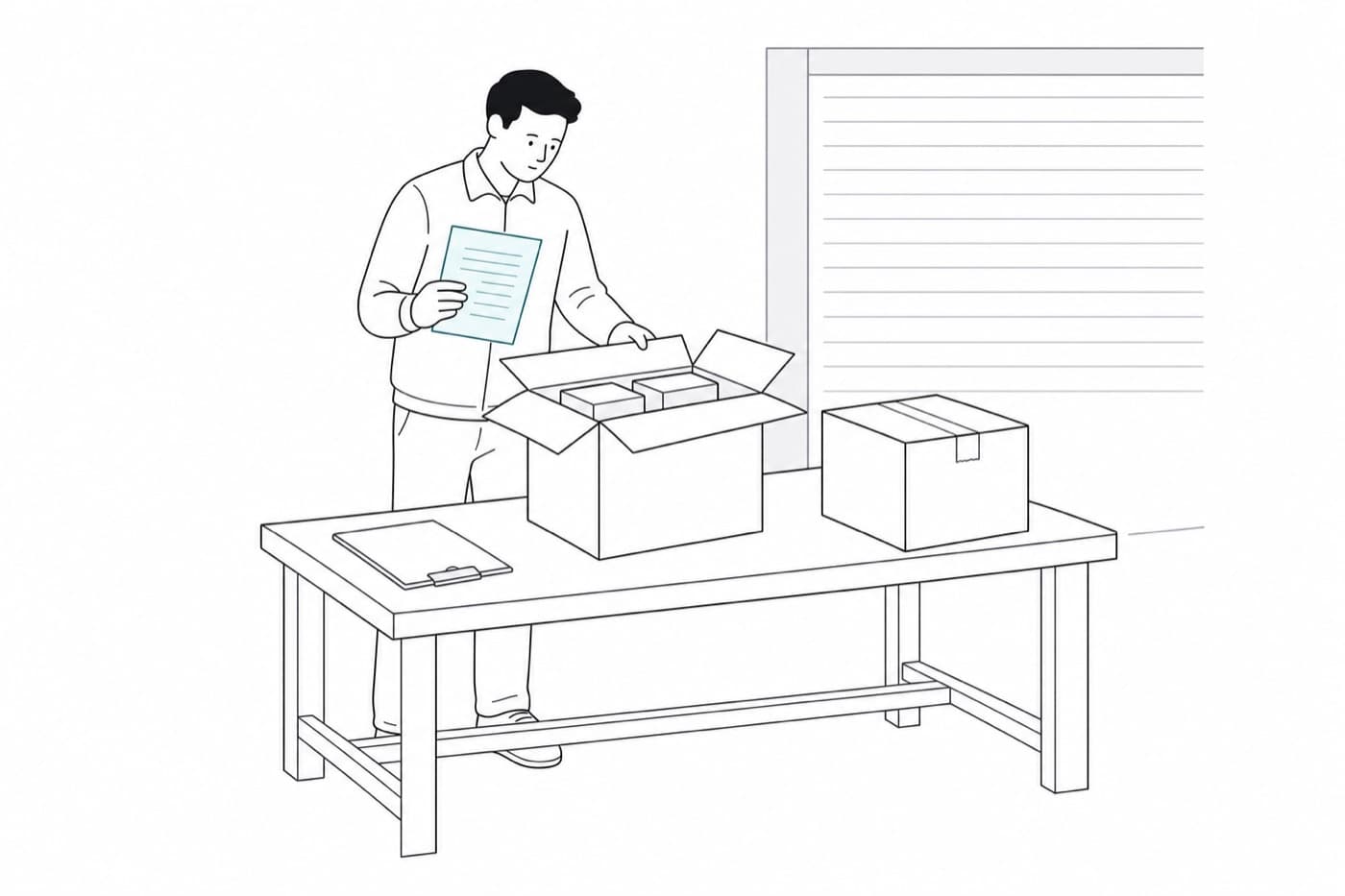
Take a slip with one quantity column into a receiving bay and watch what happens. The cartons are open, the slip lists eight lines, and every line matches what is in front of the receiver, because the slip only ever described what was packed. Nothing on the document is wrong. Nothing on it is useful either, because the question is not what is here, it is what is missing.
To answer that, the receiver has to find the purchase order, which is in a system they may not have open, held by a person who may not be in. So the delivery is signed for, put away, and the shortage surfaces days later when the line is picked and comes up empty. By then the driver has gone, no exception was written, and the supplier’s reasonable position is that a signed clean receipt says everything arrived.
Two columns close that. The supplier already knows what was ordered: they are packing against it, so printing it costs nothing and turns the slip into a statement about the order rather than about the box. A line reading ordered 10, shipped 6 is a shortage the supplier has declared in writing before anyone opened anything, and the conversation that follows is about when the four are coming rather than about whether they were ever sent.
Why there is no price column
People ask for one, so it is worth saying why it is missing rather than leaving it to look like an oversight. A packing slip travels with the goods, which means it is read by people who are not party to the commercial relationship: the carrier, the receiving warehouse, a third-party fulfilment operation, and on a drop shipment the end customer of a reseller.
A slip with unit prices on it tells that end customer exactly what the reseller paid. It is one of the most common ways a margin gets disclosed by accident, and it is entirely avoidable, because the document that carries prices already exists and goes to the people entitled to see them.
If you need a priced document to travel with goods, what you want is a commercial invoice, and it is a different document with different rules.
The count is where the buyer’s position is fixed
This is the part worth reading whichever end of the delivery you are at, because the receiving side of it is far less forgiving than most people assume.
U.C.C. § 2-513 gives the buyer a right to inspect before payment or acceptance. § 2-601 then says that where the goods or the tender fail in any respect to conform, the buyer may reject the whole, accept the whole, or accept some commercial units and reject the rest, which is the option most people take without knowing it has a name.
But § 2-606 says acceptance also happens by failing to reject after a reasonable opportunity to inspect, or by doing anything inconsistent with the seller still owning the goods. Putting a pallet away is that second thing. And § 2-607(3)(a) is the sting: a buyer who has accepted must notify the seller of a breach within a reasonable time of discovering it, or be barred from any remedy.
Hence the ruled Received by block on the slip above, and the sentence next to it. The two minutes spent counting before signing are what keep every one of those options open.
One thing the exception does not do is start a freight claim. 49 CFR § 370.3(c) says a notation of shortage or damage on a delivery receipt does not, standing alone, meet the claim filing requirements. It is the evidence. The claim is a separate written document, and our claim deadline calculator writes one.
Which document says what
| Document | Issued by | Travels | Carries prices |
|---|---|---|---|
| Purchase order | The buyer | To the supplier, before anything ships | Yes |
| Packing slip | The supplier | In or on the shipment | No |
| Bill of lading | The shipper, signed by the carrier | With the driver | No |
| Goods received note | The buyer | Stays with the buyer | No |
| Invoice | The supplier | To accounts payable | Yes |
The three that get confused are the packing slip, the bill of lading and the invoice, and the quickest way to keep them apart is to ask who signs. Nobody signs a packing slip except the person receiving the goods. The bill of lading is signed by the carrier, because it is a receipt for freight rather than for contents. The invoice is signed by nobody and paid by accounts.
The packing list customs wants is a different document
A domestic packing slip is a trade document. No statute says what has to be on it, which is why the conventions vary and why a good one is a matter of judgement rather than compliance.
Cross a border and that changes. For merchandise imported into the United States, 19 CFR § 141.86(e), a subsection actually headed “Packing list”, requires each invoice to state in adequate detail what merchandise is contained in each individual package. That is a requirement about the entry documentation, package by package, and it is why export shipments travel with a commercial invoice and a packing list prepared to that standard rather than with a slip like this one.
Use this generator for domestic shipments. For anything crossing a border, prepare the customs documents to that standard and take advice from your broker.
What this generator does, and what it does not
It runs entirely in your browser
Everything you type stays on your machine. The draft is saved in this browser's local storage so a reload does not lose your work, and Clear removes it. There is no account, no upload and no server that could hold a copy.
It states the difference on every line
Ordered against shipped, the balance to follow, and a status of complete, short, to follow or over. The foot counts how many lines do not match the order, which is the number the receiver actually wants.
It is not a customs document
For goods crossing a US border the packing detail is a requirement of the entry invoice under 19 CFR 141.86(e). This is a domestic trade document and should not be used in its place.
It does not track anything
It prints one slip. It does not number them, remember what you sent, or reconcile what arrived against the order. Those are different jobs and it would be dishonest to imply a form does them.
Questions
- Is this packing slip template free?
- Yes. Fill it in on the page, print it or save it as a PDF, and put it in the box. There is no account, no email address and no watermark. Nothing you type is transmitted: the draft is held in your own browser so a reload does not cost you the typing, and Clear removes it.
- What is a packing slip?
- A document the supplier puts in or on the shipment listing what is inside it. Its job is to let whoever opens the carton check the contents against what was ordered without needing the commercial paperwork. Under U.C.C. § 2-503 a seller tendering delivery must give the buyer any notification reasonably necessary to enable them to take delivery, and the slip in the box is that notification in ordinary practice.
- What is the difference between a packing slip and an invoice?
- A packing slip says what was sent. An invoice asks to be paid for it. They are separate on purpose: the slip travels with the goods and is read at a loading bay, the invoice goes to accounts. Comparing the two against the purchase order is three-way matching, and it is what catches being billed for twelve when ten arrived.
- Should a packing slip show prices?
- No, and this generator does not have a price column. A packing slip is read by people who are not party to the commercial deal: the carrier, the receiving warehouse, sometimes the end customer of a reseller. Putting unit prices on it is how a drop-shipped order tells the customer exactly what the reseller paid. Prices belong on the invoice.
- Why does the slip show ordered and shipped as two columns?
- Because that is the difference between a packing slip and a list of contents. With one quantity column, the receiver has to reconstruct the order from another document to notice anything missing, which usually means the shortage is found hours later at the point of putting stock away rather than at the bay while the driver is still there. With both columns and the balance beside them, a short line is something the supplier has already declared.
- Does the packing slip need the purchase order number?
- Yes, and it is the single field that most affects whether a delivery can be received quickly. Without it, the person at the bay has cartons, a list of items and no way to tell which of several open orders with that supplier this shipment satisfies. It goes in the masthead of the slip above, next to the slip's own number.
- What should I write on the packing slip if the delivery is short or damaged?
- Write it on both copies before you sign, specifically: how many pieces are missing, which lines, and what the damage looks like. The slip above has a ruled Exceptions block for exactly this. A signature with nothing noted is evidence the goods arrived in apparent good order. Be aware the exception is not itself a freight claim: 49 CFR § 370.3(c) says a notation of shortage or damage on a delivery receipt does not, standing alone, meet the claim filing requirements.
- Do I have to accept a short delivery?
- Not necessarily. U.C.C. § 2-601 is the perfect tender rule: where the goods or the tender fail in any respect to conform to the contract, the buyer may reject the whole, accept the whole, or accept any commercial units and reject the rest. In practice most buyers accept the good lines and query the rest, which is a choice the section explicitly allows. Your contract with the supplier, and instalment-contract rules, can change this.
- Is a packing slip the same as a packing list for customs?
- No. A domestic packing slip is a trade document with no statutory content. For goods imported into the United States, 19 CFR § 141.86(e) requires the invoice to state in adequate detail what is contained in each individual package, which is why an export shipment travels with a commercial invoice and a packing list prepared to that standard. Use this generator for domestic shipments and take customs advice for cross-border ones.
- Where does the packing slip go, in the box or on it?
- Conventionally in the box, with a copy in a document wallet on the outside of the lead carton so it can be read without opening anything. Where a shipment is more than one carton, put the full slip with carton one and mark each carton with its number in the sequence, so a receiver knows immediately whether they have all of them.
Sources
- 01U.C.C. § 2-503: Manner of Seller's Tender of Delivery · Legal Information Institute, Cornell Law SchoolTender requires the seller to put and hold conforming goods at the buyer's disposition and give the buyer any notification reasonably necessary to enable them to take delivery. The slip in the box is that notification.
- 02U.C.C. § 2-513: Buyer's Right to Inspection of Goods · Legal Information Institute, Cornell Law SchoolThe right to inspect goods before payment or acceptance, at any reasonable place and time.
- 03U.C.C. § 2-601: Buyer's Rights on Improper Delivery · Legal Information Institute, Cornell Law SchoolThe perfect tender rule. Where goods or the tender fail in any respect to conform, the buyer may reject the whole, accept the whole, or accept any commercial units and reject the rest.
- 04U.C.C. § 2-606: What Constitutes Acceptance of Goods · Legal Information Institute, Cornell Law SchoolAcceptance happens by saying the goods conform, by failing to reject after a reasonable chance to inspect, or by acting inconsistently with the seller's ownership.
- 05U.C.C. § 2-607: Effect of Acceptance; Notice of Breach · Legal Information Institute, Cornell Law SchoolSubsection (3)(a): a buyer who has accepted must notify the seller of a breach within a reasonable time after discovering it, or be barred from any remedy.
- 0649 CFR § 370.3: Filing of claims · Electronic Code of Federal RegulationsSubsection (c): a notation of shortage or damage on a delivery receipt does not, standing alone, meet the requirements for filing a freight claim. The exception is evidence, not the claim.
- 0719 CFR § 141.86: Contents of invoices and general requirements · Electronic Code of Federal RegulationsSubsection (e), headed Packing list: each invoice for merchandise imported into the United States must state in adequate detail what is contained in each individual package.
This describes how the rules generally work in the United States and links to the primary sources so you can read them yourself. It is not legal advice, and your contract with a supplier or carrier can change any of it. For money that matters, ask a lawyer.
A good packing slip tells the receiver what to look for. Something still has to check that it was there, count it, and keep the record. DockCount reads the slip from a phone at the bay, checks it against the purchase order line by line, and keeps the photographs. Free for 25 deliveries a month.