Free tool · Freight classification
Your density, and the class it points to.
Measurements and a weight give you pounds per cubic foot and an estimated NMFC class, worked out on the thirteen band density scale that replaced the old eleven in July 2025. The arithmetic is on the page, because the argument with a carrier is always about a number. If you want the background first, start with what a freight class is and what it costs you.
Measure the handling unit as the carrier will receive it: the greatest straight-line length, width and height including the pallet, the shrink wrap and anything sticking out. That last part is where most of the disagreements start.
Nothing here is sent anywhere. The whole calculation runs in your browser as you type.
Put in the weight and the estimate appears here, with the arithmetic behind it.
Density worksheet
The measurements and the arithmetic on one page, to attach to a bill of lading or send to a carrier who disagrees.
Freight density worksheet
- Commodity
- —
- Reference
- —
- Handling unit
- —
- Weight per unit
- —
- Cube per unit
- —
- Handling units
- —
- Density
- —
- Estimated class
- —
An estimate from density, worked out to the NMFC density scale in force since 19 July 2025. The NMFC is a voluntary standard and density is the primary factor rather than the only one: handling, stowability and liability can move a commodity off its density class, and the carrier classifies against the NMFC item for the commodity itself. Confirm the item in ClassIT+ or with your carrier before tendering.
The density scale in force
Thirteen subprovisions since Docket 2025-1 took effect on 19 July 2025, which replaced the eleven that came before it. The old scale ended at “30 pcf or greater, class 60”; classes 55 and 50 did not exist on it. Tables published before that date are still circulating and are wrong at the dense end.
| Sub | Density, pounds per cubic foot | Class |
|---|---|---|
| 1 | Less than 1 | 400 |
| 2 | 1 but less than 2 | 300 |
| 3 | 2 but less than 4 | 250 |
| 4 | 4 but less than 6 | 175 |
| 5 | 6 but less than 8 | 125 |
| 6 | 8 but less than 10 | 100 |
| 7 | 10 but less than 12 | 92.5 |
| 8 | 12 but less than 15 | 85 |
| 9 | 15 but less than 22.5 | 70 |
| 10 | 22.5 but less than 30 | 65 |
| 11 | 30 but less than 35 | 60 |
| 12 | 35 but less than 50 | 55 |
| 13 | 50 or greater | 50 |
What changed, and why old tables are wrong
The scale grew two bands in July 2025
Docket 2025-1 took effect on 19 July 2025 and expanded the Freight Classification Development Council’s density scale from eleven subprovisions to thirteen. It also made density the primary factor in classification rather than one factor among several, which is the larger change and the one that made the scale worth getting right.
The practical difference is at the dense end. The eleventh subprovision used to read “30 pounds per cubic foot or greater” and carry class 60, and that was the floor. It now stops at 35, a twelfth band runs to 50 at class 55, and a thirteenth covers everything at 50 or greater at class 50.
So a pallet of machined parts at 45 pounds per cubic foot was class 60 before that date and is class 55 after it. If you are working from a chart that ends at class 60, the chart predates the change and it is costing money on your densest freight.
| Density | Before 19 July 2025 | Now |
|---|---|---|
| 30 but less than 35 | Class 60 | Class 60 |
| 35 but less than 50 | Class 60 | Class 55 |
| 50 or greater | Class 60 | Class 50 |
Three ways the measurement goes wrong
Reclassification is rarely a disagreement about the scale. It is a disagreement about what was measured, and the carrier has a dimensioner at the dock while you had a tape measure and a hurry.
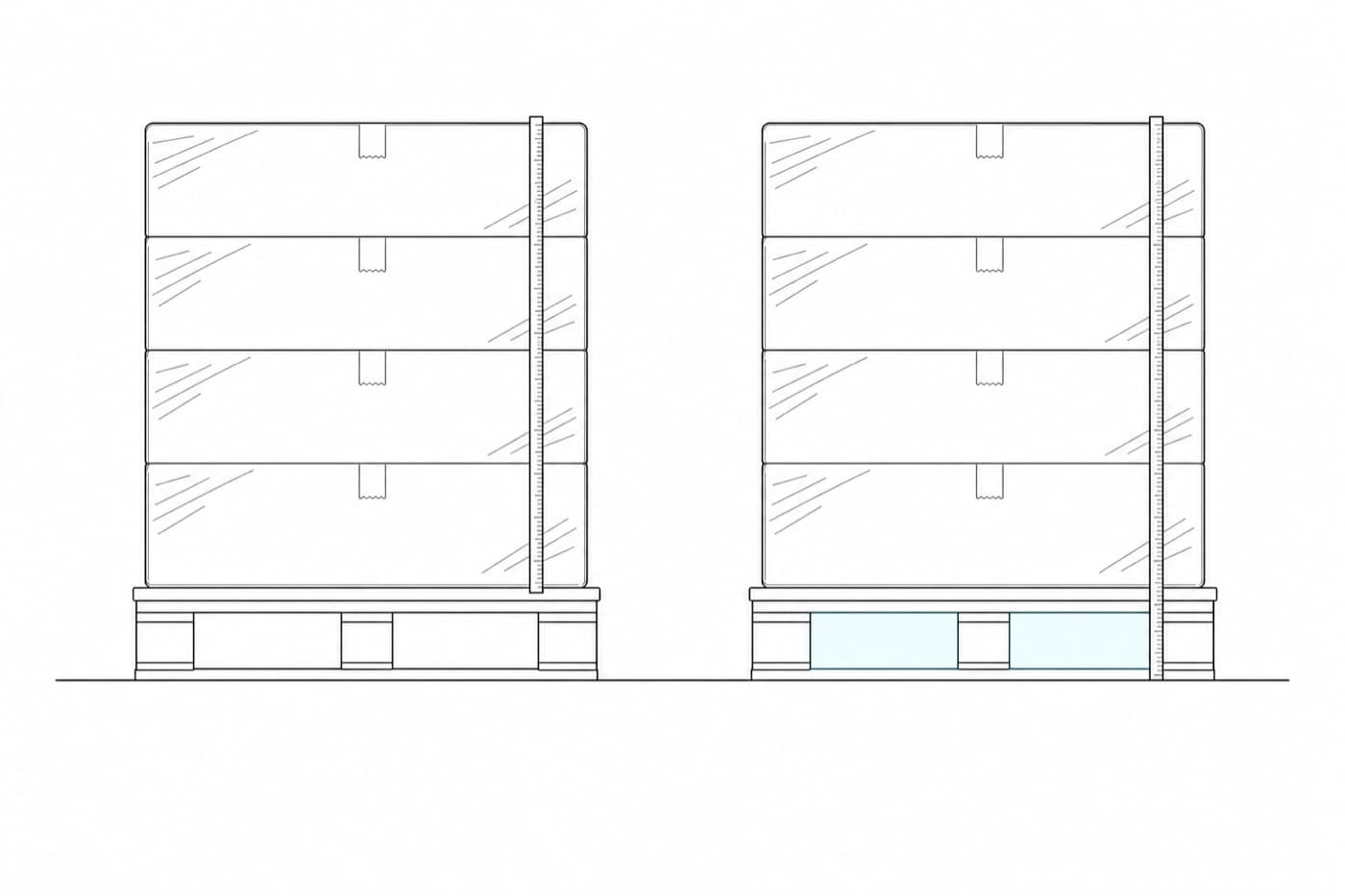
- 01
The pallet was left out of the height
A standard wooden pallet adds about six inches. On a load that is 40 inches of product at 450 lb, forgetting it reads as class 92.5 when the shipment is class 100, which the carrier finds at the dock. We worked that example through alongside the standard pallet sizes.
- 02
Shrink wrap and overhang were not counted
The rule is the greatest straight-line dimension including all projections, as tendered. A carton hanging two inches past the pallet edge on two sides makes the footprint 44 by 44, not 40 by 40.
- 03
The dimensions came from an old record
The most expensive of the three, because it is invisible. Nothing looks wrong on the paperwork until the carrier measures a load that has been repacked since the record was written.
What density cannot tell you
Density is the primary factor in the NMFC and it is not the only one. Three others can move a commodity off the class its density suggests, and all three are judgements about the goods rather than measurements of them.
Stowability
Whether it loads with other freight. Excessive length, an awkward shape, or a hazardous material that cannot travel beside certain goods all cost trailer space the density figure does not see.
Handling
Whether it moves through a terminal normally. Anything that cannot be forklifted, stacked or conveyed takes labour that the weight and cube do not account for.
Liability
What it costs the carrier if it goes wrong. Value per pound, fragility, perishability, and the risk of damaging the freight around it.
NMFTA puts it plainly in its own classification FAQ: items that have handling, stowability or liability concerns will not be full density. So the class above is where the conversation starts.
On NMFC codes, and why this page has none
Plenty of people arrive at a page like this looking for an NMFC item number rather than a class, and it is worth saying clearly why they will not find one here. We set out what the classification is and how the four factors work separately.
The National Motor Freight Classification is NMFTA’s copyrighted publication. The item list is licensed, through the ClassIT+ subscription that is the official digital version of it. Reproducing that list on a free tool page would be republishing somebody else’s property, and a site that appears to give you item numbers for nothing is doing that or guessing at them.
The density arithmetic is different. It is published openly by NMFTA, this page cites where, and it is genuinely the larger half of the answer now that density is the primary factor. For the item number itself, ClassIT+ and your carrier’s classification desk are the two places that can actually tell you, and NMFTA runs an interpretations service for commodities that do not fit neatly.
Questions
- How do you calculate freight class from dimensions and weight?
- Multiply the greatest straight-line length, width and height of the handling unit in inches, including the pallet and anything projecting from the load, then divide by 1,728 to get cubic feet. Divide the weight in pounds by that figure and you have density in pounds per cubic foot. That density falls into one of thirteen subprovisions, each of which the NMFC assigns a class. NMFTA's own worked example is a pallet measuring 48 by 40 by 45 inches weighing 450 pounds: 86,400 cubic inches, 50 cubic feet, 9.00 pounds per cubic foot, which is sub 6 and class 100.
- What is the density scale for freight class?
- Thirteen bands. Under 1 pound per cubic foot is class 400, then 1 to 2 is 300, 2 to 4 is 250, 4 to 6 is 175, 6 to 8 is 125, 8 to 10 is 100, 10 to 12 is 92.5, 12 to 15 is 85, 15 to 22.5 is 70, 22.5 to 30 is 65, 30 to 35 is 60, 35 to 50 is 55, and 50 or greater is 50. Each band is inclusive at the bottom and exclusive at the top, so a shipment at exactly 35.00 pounds per cubic foot is class 55 rather than 60.
- Did the freight class rules change in 2025?
- Yes, and it is the reason several tables on the internet are now wrong. Docket 2025-1 took effect on 19 July 2025 and expanded the Freight Classification Development Council's density scale from eleven subprovisions to thirteen. The old scale stopped at 30 pounds per cubic foot or greater, class 60. The new one splits that into three bands and introduces classes 55 and 50, so dense freight can now take a lower class than it could before. Docket 2025-2 followed in December 2025 and further dockets have come since, mostly cancelling individual commodity items rather than touching the density scale.
- Can this tool look up an NMFC code?
- No, and no free tool honestly can. The NMFC item list is NMFTA's copyrighted publication, licensed through their ClassIT+ subscription, so a site that hands you item numbers for free is either republishing someone else's property or guessing. What this page does instead is the part that does not require their data: the density arithmetic, and the class that density alone points to. For the item number itself, use ClassIT+ or ask your carrier's classification desk, both of which are linked in the sources.
- Why did my carrier reclassify my shipment?
- Usually because their dimensioner measured the freight differently than you did. The three that come up most are a pallet left out of the height, shrink wrap and overhang not counted in the length or width, and dimensions carried over from an old record for a load that has since changed. All three make the shipment look denser than the carrier finds it, which means a lower class on your paperwork and a back charge when they weigh and measure it themselves.
- Is a class from density always the class the carrier uses?
- No. Density is the primary factor and it is not the only one. An item with handling, stowability or liability concerns does not take its full density class, and the carrier classifies against the NMFC item that describes the commodity rather than against the density in isolation. Something fragile, hazardous, awkwardly shaped or unusually valuable can sit above what its density suggests. Treat the number here as the floor of the conversation rather than the end of it.
- Does the number of pallets change the freight class?
- No. Density is measured per handling unit, so ten identical pallets classify the same as one. What the count changes is the total cube and total weight on the bill of lading, and whether the shipment is still economic as LTL at all. Where the pallets are not identical, each one is its own handling unit and gets its own density.
Sources
- 01How is the density of a handling unit calculated? · NMFTA Help CenterThe formula: greatest straight-line length, width and height in inches including all projections, divided by 1,728, then the weight divided by that. The worked example is 48 by 40 by 45 inches at 450 pounds, which is 9.00 pcf.
- 02Can you share with us the density and class breaks for the new 13 sub-structure? · NMFTA Help CenterDocket 2025-1 expanded the eleven subprovision scale to thirteen. Sub 11 became 30 but less than 35 at class 60, sub 12 is 35 but less than 50 at class 55, sub 13 is 50 or greater at class 50.
- 03NMFC Classification FAQs · NMFTA Help CenterStates that the NMFC is a voluntary standard, that density became the primary factor in 2025, and that items with handling, stowability or liability concerns do not take their full density class.
- 04Navigating Updates to the National Motor Freight Classification · National Motor Freight Traffic AssociationWhere the current docket files and the official ClassIT+ lookup live. The classification keeps moving, so this is the page to check rather than any article about it, including this one.
NMFC® and National Motor Freight Classification® are registered trademarks of the National Motor Freight Traffic Association, Inc. This page is not affiliated with NMFTA, quotes no part of the classification itself, and describes how the published density scale works so you can apply it to your own freight. Classification changes: check the current dockets before you rely on any figure here, including these.
Classification decides what a delivery costs to move. What actually came off the truck decides whether you were billed correctly for it, and that is the record almost nobody keeps. DockCount checks the packing slip against the purchase order and keeps the photographs. Free for 25 deliveries a month.