Receiving 101 · Freight
The six standard sizes, and the six inches nobody measures.
Pallet footprints are easy to look up and the chart is below. The part worth reading is the height, because the pallet is under the goods when the carrier receives them, and leaving it out of the measurement is how a shipment gets reclassified and back-billed.
In short
- ISO 6780:2003 recognises six footprints. Which one is “standard” depends only on where you are.
- The Euro pallet has a published height, 144 mm. The North American 48 by 40 does not: the footprint is standardised, the rest is convention.
- Measure as the carrier receives it: greatest straight-line dimensions, including the pallet, the wrap and any overhang.
- A 6 inch pallet left out of a 40 inch load at 450 lb moves it from class 100 to an apparent 92.5, and the carrier will find it.
The six footprints in ISO 6780
ISO 6780:2003 specifies principal dimensions and tolerances for flat pallets of any material and any entry type. It recognises six footprints rather than one, which is the honest answer to “what is the standard pallet size” and the reason the question keeps being asked.
| Millimetres | Inches | Mainly used in | Notes |
|---|---|---|---|
| 1,016 × 1,219 | 40 × 48 | North America | The GMA footprint. By far the most common pallet in US freight. |
| 800 × 1,200 | 31.5 × 47.2 | Europe | The EPAL Euro pallet, and the only one on this list with a published height. |
| 1,000 × 1,200 | 39.4 × 47.2 | Europe, Asia | The industrial or EUR-2 footprint. Common in chemicals and drums. |
| 1,165 × 1,165 | 45.9 × 45.9 | Australia | Square, and sized to the rail wagons it was designed around. |
| 1,100 × 1,100 | 43.3 × 43.3 | Asia | The regional standard across much of East and Southeast Asia. |
| 1,067 × 1,067 | 42 × 42 | North America, Asia | Square, and used in some grocery and paint distribution. |
Footprints only. ISO 6780 is a paid publication, so this table gives the sizes and links the catalogue entry rather than reproducing the standard’s text. The inch figures are conversions, rounded to one decimal place.
The one with a published height
The EPAL Euro pallet is the exception on that list, because the European Pallet Association publishes the whole specification rather than only the footprint: 1,200 by 800 by 144 mm, about 25 kg unladen, a safe working load of 1,500 kg, and a maximum of 5,500 kg on the bottom pallet when laden pallets are stacked on a solid, even surface.
Nothing equivalent exists for the North American 48 by 40. The footprint is standardised, being the 1,016 by 1,219 mm entry in ISO 6780, but deck board count, stringer construction, timber, height and weight are set by the manufacturer and the grade. In practice a stringer pallet of that size runs about 6 to 6.5 inches tall and 33 to 48 pounds empty, and those are typical values rather than published ones.
The distinction matters more than it sounds, because pages that quote a single GMA height or weight as though it were a specification are quoting a typical value with the uncertainty removed. If the figure feeds into your rating, measure and weigh the pallets you actually ship on.
The part that costs money
Six inches of pallet, one freight class
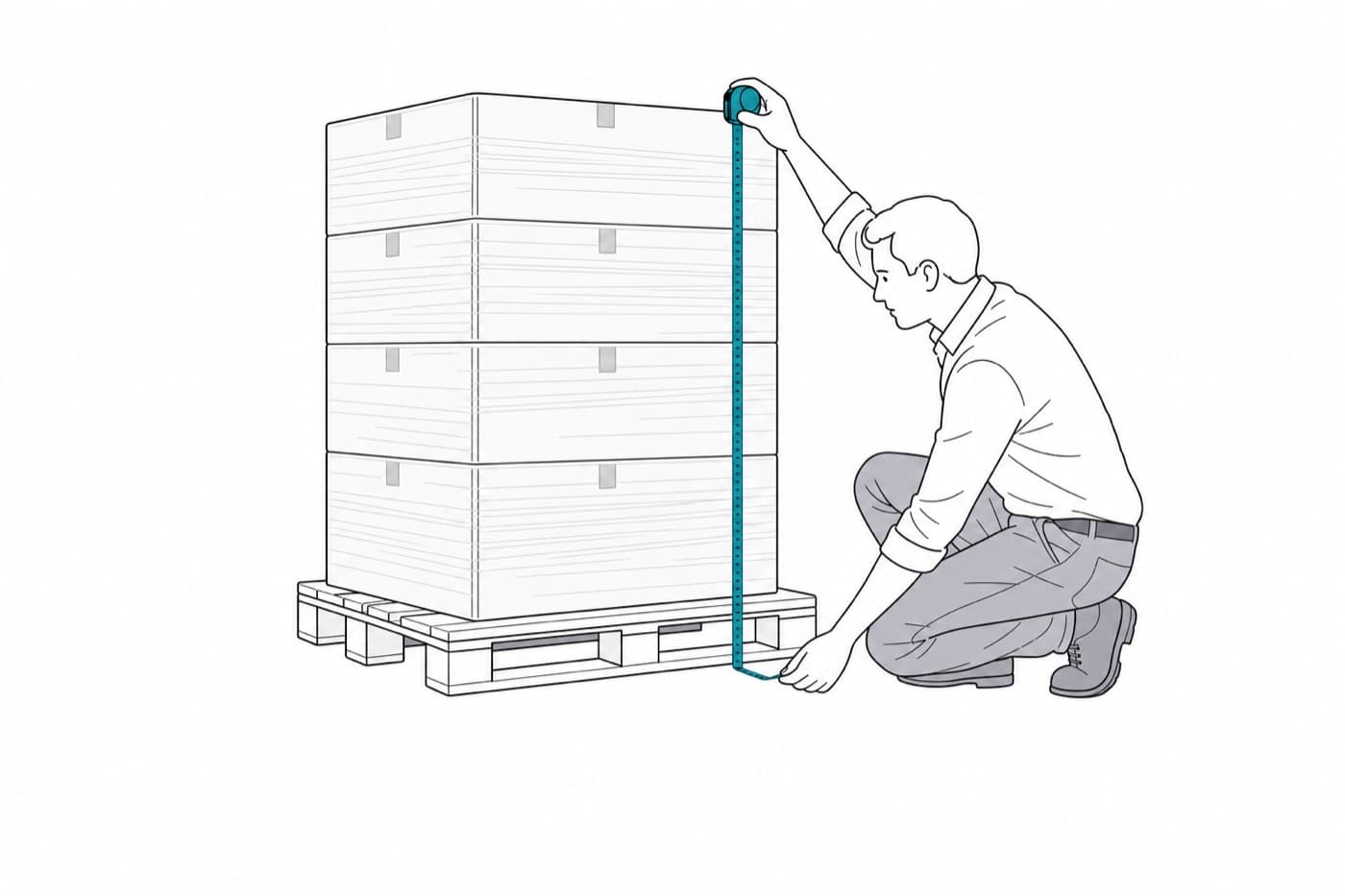
The measuring rule is not ambiguous. NMFTA’s own definition is the greatest straight-line length, width and height in inches, including all projections, as tendered to the carrier. The pallet is under the goods when they are tendered. So it counts, and so does the shrink wrap, and so does anything hanging over an edge.
NMFTA names the omission explicitly in its own guidance on density, listing “forget to include pallet or packaging height” among the errors it sees shippers make. Here is what it costs.
| 48 × 40 in, 450 lb | Measured | Cubic feet | Density | Class |
|---|---|---|---|---|
| Product only | 40 in | 44.44 | 10.13 pcf | 92.5 |
| With the pallet | 46 in | 51.11 | 8.80 pcf | 100 |
Same pallet, same goods, same weight. Six inches of timber moves the density across the break at 10 pounds per cubic foot, and the class with it. The version on your bill of lading says 92.5. The carrier’s dimensioner at the dock says 100, and the difference arrives later as a re-rating.
Both rows were computed with the same module that runs our freight class calculator, on the thirteen band density scale in force since July 2025, rather than worked out by hand for the page. Put your own figures in and check the break you are nearest to.
Overhang, wrap, and the other projections
Height is the one people forget. The footprint is the one people underestimate, because a load is measured at its widest point rather than at the pallet edge.
Cartons hanging two inches past the pallet on two sides make a 48 by 40 footprint 52 by 44, which is a ten per cent increase in cube before anything else is counted. A corner post, a protruding fitting, a strap buckle and a shrink wrap skirt all do the same on a smaller scale. Overhang is also the fastest way to damage the goods, since anything past the pallet edge is unsupported and takes the impact of every other pallet in the trailer.
Measure the widest and tallest points of the finished, wrapped unit, then write those figures on the bill of lading. Measuring the pallet instead of the load is the same class of error as leaving the pallet out of the height, in the other direction.
How many fit in a trailer, worked rather than quoted
Numbers get quoted for this and they depend on a trailer you may not have, so here is the arithmetic instead, with its assumptions visible.
Take roughly 630 inches of usable floor length and a little over 100 inches of internal width, which is about what a 53 foot dry van gives you. Straight-loaded with the 40 inch face forward, two 48 by 40 pallets sit side by side across 80 inches, and 630 divided by 48 gives 13 rows: 26 pallets on the floor. Turn alternate rows through ninety degrees and you fit more, at the cost of a load that has to be planned rather than pushed on.
What actually decides it is your trailer’s real internal dimensions, whether the load can be double stacked, and the axle weights. Measure the trailer once and keep the number; it will be more use than any figure from a website.
Questions
- What is the standard pallet size?
- There is no single one. ISO 6780:2003 recognises six footprints: 1,016 by 1,219 mm, 800 by 1,200 mm, 1,000 by 1,200 mm, 1,165 by 1,165 mm, 1,100 by 1,100 mm and 1,067 by 1,067 mm. Which of them counts as standard depends entirely on where you are: in North America it is the 48 by 40 inch GMA pallet, in Europe the 1,200 by 800 mm Euro pallet, in Australia the 1,165 mm square.
- What are the dimensions of a standard US pallet?
- 48 inches by 40 inches, which is 1,219 by 1,016 mm and the same footprint as one of the six in ISO 6780. Height and weight are not standardised the way the footprint is: a stringer pallet of this size is typically around 6 to 6.5 inches tall and weighs somewhere between 33 and 48 pounds empty, depending on timber, moisture and how many times it has been repaired.
- What are the dimensions of a Euro pallet?
- 1,200 mm long by 800 mm wide by 144 mm high, which is about 47.2 by 31.5 by 5.7 inches. EPAL publishes the rest of the specification too: roughly 25 kg unladen, a safe working load of 1,500 kg, and a maximum of 5,500 kg on the bottom pallet when laden pallets are stacked on a solid, even surface.
- Do I include the pallet when I measure a shipment?
- Yes, and it is the single most expensive measuring mistake in LTL freight. NMFTA's rule is the greatest straight-line length, width and height in inches, including all projections, as tendered to the carrier. The pallet is under the goods when the carrier receives them, so its height is part of the height, and the shrink wrap and any overhang are part of the footprint.
- How much does forgetting the pallet cost?
- It can move you a whole freight class. Take a 48 by 40 inch load standing 40 inches of product on a 6 inch pallet, weighing 450 pounds. Measured without the pallet it is 44.44 cubic feet and 10.13 pounds per cubic foot, which is class 92.5. Measured properly at 46 inches it is 51.11 cubic feet and 8.80 pounds per cubic foot, which is class 100. The carrier measures it their way at the dock, reclassifies it, and back-bills the difference.
- How tall is a standard pallet?
- The Euro pallet is 144 mm, which EPAL publishes as part of the specification. For the North American 48 by 40 there is no published figure, because the GMA footprint is a trade convention rather than a dimensional standard; in practice they run about 6 to 6.5 inches. If the number matters to your rating, measure the ones you actually ship on rather than taking a figure from a website, including this one.
- How many pallets fit in a 53 foot trailer?
- Do the arithmetic on your own trailer rather than trusting a number. A 53 foot trailer gives roughly 630 inches of usable floor length and a little over 100 inches of width. Straight-loaded with the 40 inch face forward, two 48 by 40 pallets sit side by side across 80 inches of width, and 630 divided by 48 gives 13 rows, so 26 pallets. Turning some rows through 90 degrees fits more. What actually decides it is your trailer's real internal dimensions and whether the load can be double stacked.
- Is the 48 by 40 GMA pallet an official standard?
- The footprint appears in ISO 6780 as 1,016 by 1,219 mm, so the size is standardised. What is not standardised is the rest of it: deck board count, stringer construction, timber, height and weight vary between manufacturers and grades. Pages that quote a single GMA weight or height as though it were published are quoting a typical value, and this one says so.
Sources
- 01ISO 6780:2003: Flat pallets for intercontinental materials handling: principal dimensions and tolerances · International Organization for StandardizationThe international standard for pallet footprints. Published December 2003, corrected version April 2004, and confirmed as current on review. The standard itself is a paid publication, so the catalogue entry is linked rather than its text reproduced.
- 02EPAL Euro pallet · European Pallet AssociationPublishes the Euro pallet's figures directly: 1,200 by 800 by 144 mm, roughly 25 kg unladen, a safe working load of 1,500 kg, and a maximum of 5,500 kg on the bottom pallet of a laden stack.
- 03How is the density of a handling unit calculated? · NMFTA Help CenterThe measurement rule that makes pallet height billable: the greatest straight-line length, width and height in inches, including all projections, as tendered to the carrier.
- 04Decoding Density: The Freight Factor You Can't Afford to Overlook · National Motor Freight Traffic AssociationNames forgetting to include pallet or packaging height among the errors NMFTA sees shippers make, and publishes the thirteen density breaks the class is read from.
NMFC® and National Motor Freight Classification® are registered trademarks of the National Motor Freight Traffic Association, Inc. EPAL® is a registered trademark of the European Pallet Association. This page is not affiliated with either and reproduces no part of a licensed publication.
This describes how the rules generally work in the United States and links to the primary sources so you can read them yourself. It is not legal advice, and your contract with a supplier or carrier can change any of it. For money that matters, ask a lawyer.
The dimensions decide what the delivery costs to move. What actually came off the pallet decides whether you were billed correctly for it. DockCount checks the packing slip against the purchase order at the bay and keeps the photographs. Free for 25 deliveries a month.