Receiving 101 · Freight
Why the lighter pallet costs more to move.
Freight class is how a carrier charges for the space a shipment takes rather than only for what it weighs. It runs from 50 to 500, it is decided mostly by density since July 2025, and it is the number on your bill of lading that most changes what the bill says.
In short
- A trailer runs out of space long before it runs out of weight. Class prices the space.
- 50 is the densest and cheapest, 500 the lightest and dearest. Thirteen of the eighteen classes come off the density scale.
- Since Docket 2025-1 density is the primary factor, and class 50 became reachable for the first time.
- Reclassification is almost never a disagreement about the scale. It is a disagreement about what was measured.
What the number is for
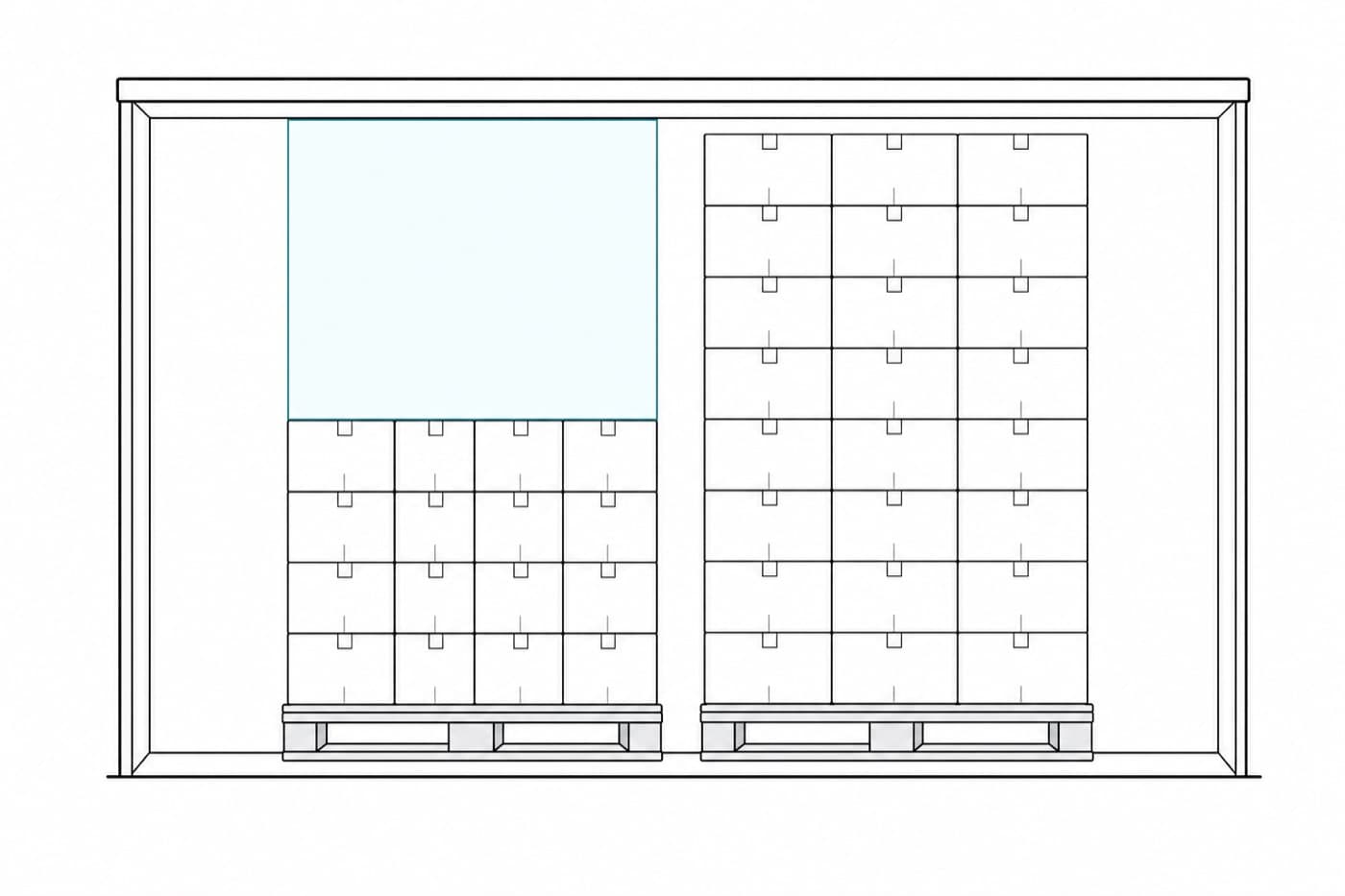
A less-than-truckload carrier is selling shared space. Your pallets travel with other people’s, and what the carrier is really selling you is a share of a trailer that has both a weight limit and a volume limit. Most loads hit the volume limit first.
So charging by weight alone would let a shipment of something very light occupy half a trailer for the price of a few hundred pounds, and the carrier would be unable to sell that space to anybody else. Freight class is the mechanism that prices what your goods actually consume.
In broad terms, a carrier rates from a tariff by weight and class, and a higher class carries a higher rate per hundred pounds. The actual figure comes from your carrier’s published tariff and whatever you have negotiated, so nobody can tell you what a class costs without knowing both.
What each band means
Thirteen bands, from the lightest freight to the densest. The density ranges here come from the same scale that runs our calculator, so the two cannot disagree.
| Class | Density, lb per cubic foot | What freight at that density looks like |
|---|---|---|
| 50 | 50 or greater | The densest freight moves. Metal, stone, liquids in compact packaging. |
| 55 | 35 but less than 50 | Very dense indeed. This band and the one below it did not exist before July 2025. |
| 60 | 30 but less than 35 | Dense. Bar stock, plate, machined components on a compact pallet. |
| 65 | 22.5 but less than 30 | Very dense. Fasteners, castings, packaged metal parts. |
| 70 | 15 but less than 22.5 | Heavy for its size. Hardware, fittings, dense components. |
| 85 | 12 but less than 15 | Solid, well-packed freight. Cased goods with little void. |
| 92.5 | 10 but less than 12 | Denser than average. Compact packaged goods, or a lighter product packed tightly. |
| 100 | 8 but less than 10 | The centre of gravity of ordinary LTL freight. NMFTA's own worked example, a 48 by 40 pallet at 450 lb, is 9.00 pcf and sits here. |
| 125 | 6 but less than 8 | Middling. Mixed pallets of packaged goods often land in this band without anyone aiming for it. |
| 175 | 4 but less than 6 | Moderately light. Assembled products with a lot of void space inside the carton. |
| 250 | 2 but less than 4 | Light and bulky, but stacking. A lot of packaged consumer goods sit around here once the pallet is counted. |
| 300 | 1 but less than 2 | Very light for its size. Large cartons of foam, plastics or soft goods measured over their packaging. |
| 400 | Less than 1 | Almost entirely air. Bulky, light and easily crushed, and the freight that costs most per pound to move. |
The right-hand column describes what a shipment measuring at that density tends to be. It is not a list of commodity assignments: a class belongs to an NMFC item, and the same goods packed differently land in different bands, which is the point of the illustration above. Five further classes, 77.5, 110, 150, 200 and 500, are not on the density scale at all, and we explain what that tells you on the classification page.
Asked by number
What class 70, 250 and 300 actually mean
People look these up by number, usually because one has turned up on a quote or a re-rating. Each is a density band, and each answer below carries a real pallet that lands on it: open the link and the calculator shows the arithmetic.
What is class 70 freight?
Freight measuring 15 but less than 22.5 pounds per cubic foot. Dense, well-packed goods with very little void in the carton. Hardware, fittings, cased components, machine parts: freight that is heavy for the space it takes and therefore cheap to move per pound.
A pallet that lands on class 70
48 × 40 × 48 in at 960 lb is 53.33 cubic feet and 18.00 pounds per cubic foot.
Open this calculationPack the same goods with more void and the density falls; a load that measures 14 pounds per cubic foot is class 85 rather than 70, and nothing about the product has changed.
What is a 250 freight class?
Freight measuring 2 but less than 4 pounds per cubic foot. Light and bulky: freight taking a great deal of trailer space for its weight. Large cartons of packaging, plastics, or assembled products with a lot of air inside them, which is most of what lands here once the pallet is counted.
A pallet that lands on class 250
48 × 40 × 60 in at 200 lb is 66.67 cubic feet and 3.00 pounds per cubic foot.
Open this calculationThis band is where packing decisions show up hardest. Getting the same goods into a shorter pallet moves a shipment two or three classes, because the scale is steepest at the light end.
What does freight class 300 mean?
Freight measuring 1 but less than 2 pounds per cubic foot. Very light for its size, and among the more expensive freight to move per pound. Only class 400, under 1 pound per cubic foot, sits lighter on the density scale.
A pallet that lands on class 300
48 × 40 × 72 in at 120 lb is 80.00 cubic feet and 1.50 pounds per cubic foot.
Open this calculationAt this density the trailer runs out of room long before it runs out of weight, so the carrier is selling you space. Anything that reduces height, whether nesting, knocking down or shrinking the void, pays back immediately.
All three are what density alone points to. A class belongs to an NMFC item, and handling, stowability or liability can move a commodity off the band its density suggests, which is also why five of the eighteen classes never appear on the density scale at all.
How do you calculate freight class?
- 01
Measure the handling unit as tendered
Greatest straight-line length, width and height in inches, including all projections. The pallet is under the goods when the carrier receives them, so it counts, and so does the wrap and any overhang.
- 02
Work out the density
Multiply the three dimensions, divide by 1,728 for cubic feet, then divide the weight in pounds by that. NMFTA's own example is a 48 by 40 by 45 inch pallet at 450 lb, which is 50 cubic feet and 9.00 pounds per cubic foot.
- 03
Read the class off the scale
Find the band the density falls in. Our calculator does this and shows every step, including how close you are to the breaks on either side.
- 04
Confirm the item, because density is not the whole answer
Handling, stowability and liability can move a commodity off its density class. The item number is a lookup in NMFTA's licensed publication, so that half comes from ClassIT+ or your carrier.
Put your dimensions and weight into the freight class calculator and it works through all of that on the current thirteen band scale, with the arithmetic on the page rather than behind it.
NMFTA’s own example, worked: 48 × 40 × 45 in at 450 lb is 50 cubic feet and 9.00 pounds per cubic foot, which is class 100. Every calculation has its own address, so you can send one to a carrier rather than describing it.
When the carrier reclassifies you
A re-rating arrives weeks after the shipment, as a charge you did not agree to for a load you can no longer see. It is worth knowing that it is almost never a disagreement about the classification. It is a disagreement about the measurement, and the carrier has a dimensioner at the dock while you had a tape and a hurry.
The three causes, in the order we see them: the pallet was left out of the height, shrink wrap and overhang were not counted in the footprint, and the dimensions came from an old record for a load that has since been repacked. All three make the freight look denser on your paperwork than the carrier finds it, so the correction always goes the same way. Six inches of pallet is enough to move a class, and we worked that example through.
What makes a re-rating arguable is a record made at the time. 49 CFR § 373.101 requires the bill of lading to show weight, volume or measurement where it affects the rating, so put the real figures on it, and photograph the wrapped unit beside a tape before it goes. Neither costs anything and together they are the difference between disputing a correction and absorbing it.
Questions
- What is freight class?
- A number a carrier uses to rate a less-than-truckload shipment. It comes from the National Motor Freight Classification, runs from 50 for the densest freight to 500 for the lightest, and reflects how much trailer space the goods take for their weight, plus how awkward they are to stow, handle and be liable for. Since July 2025 density is the primary factor.
- Why does lighter freight cost more to ship?
- Because a trailer runs out of space long before it runs out of weight. Two pallets with the same footprint can fill very different amounts of a trailer, and the carrier cannot sell the space the taller one occupies to anybody else. Class is the mechanism that charges for that space rather than only for the weight on the axles.
- What is the lowest freight class?
- Class 50, for freight of 50 pounds per cubic foot or greater. It is the cheapest to move and it only became reachable on the density scale in July 2025, before Docket 2025-1 the scale stopped at class 60 for anything 30 pcf or denser.
- How do I find my freight class?
- Measure the handling unit as the carrier will receive it, including the pallet and any overhang, work out the density in pounds per cubic foot, and read the class off the thirteen band scale. Our freight class calculator does that arithmetic and shows its working. What that will not tell you is the NMFC item number for your commodity, or whether a handling, stowability or liability concern moves it off its density class.
- Why did my carrier change my freight class?
- Almost always because their dimensioner measured the shipment differently than you did. The three that come up most are a pallet left out of the height, shrink wrap and overhang not counted in the footprint, and dimensions carried over from an old record for a load that has since been repacked. All three make the freight look denser on your paperwork than the carrier finds it at the dock, and the correction arrives as a re-rating.
- What is an FAK agreement?
- Freight all kinds: an agreement with a carrier that several classes will be rated as one, so a shipper whose freight ranges across classes 70 to 125 might have it all rated at 85. It simplifies quoting and can save money, and it is negotiated rather than published. It does not change what the classification says your freight is; it changes what your carrier agrees to charge for it.
- Does freight class apply to full truckloads?
- Not usually. Classification is an LTL mechanism, because LTL is where a carrier is selling shared space and has to price it. A full truckload is priced on the lane and the equipment, since you are buying the whole trailer whatever you put in it.
- How do you calculate freight class?
- Measure the handling unit as the carrier will receive it: greatest straight-line length, width and height in inches, including the pallet and any overhang. Multiply the three, divide by 1,728 for cubic feet, then divide the weight in pounds by that figure. The result is density in pounds per cubic foot, and it falls into one of thirteen bands, each carrying a class. NMFTA's own worked example is a 48 by 40 by 45 inch pallet at 450 pounds: 86,400 cubic inches, 50 cubic feet, 9.00 pounds per cubic foot, which is class 100.
- What is class 70 freight?
- Freight measuring 15 but less than 22.5 pounds per cubic foot. It is dense, well-packed goods with little void: hardware, fittings, cased components, machine parts. A 48 by 40 pallet standing 48 inches including the pallet and weighing 960 pounds is 53.33 cubic feet and 18.00 pounds per cubic foot, which is class 70.
- What is a 250 freight class?
- Freight measuring 2 but less than 4 pounds per cubic foot: light and bulky, taking a lot of trailer space for its weight. A 48 by 40 pallet standing 60 inches and weighing 200 pounds is 66.67 cubic feet and 3.00 pounds per cubic foot, which is class 250. Large cartons of packaging, plastics or assembled goods with a lot of air inside them tend to measure here once the pallet is counted.
- What does freight class 300 mean?
- It means the freight measures 1 but less than 2 pounds per cubic foot: very light for its size, and among the more expensive things to move per pound. A 48 by 40 pallet standing 72 inches and weighing 120 pounds is 80 cubic feet and 1.50 pounds per cubic foot, which is class 300. Only class 400, under 1 pound per cubic foot, is lighter on the density scale.
- Can I choose a higher class to be safe?
- You can, and it costs you money for nothing. A class above what the freight actually is means paying a higher rate on every shipment to avoid a correction that would only have applied to some of them. Measure properly instead, and keep the measurements with the shipment record so a re-rating can be argued with rather than absorbed.
Sources
- 01Decoding Density: The Freight Factor You Can't Afford to Overlook · National Motor Freight Traffic AssociationPublishes the thirteen standard density breaks in full, and names forgetting pallet or packaging height among the errors NMFTA sees shippers make.
- 02NMFC Classification FAQs · NMFTA Help CenterThe NMFC is a voluntary standard, density became the primary factor in 2025, and items with handling, stowability or liability concerns will not be full density.
- 03How is the density of a handling unit calculated? · NMFTA Help CenterGreatest straight-line dimensions in inches including all projections, divided by 1,728, then the weight divided by that. The example given is 48 by 40 by 45 inches at 450 pounds, which is 9.00 pcf.
- 0449 CFR § 373.101: Motor carrier bills of lading · Electronic Code of Federal RegulationsRequires a bill of lading to show the weight, volume or measurement of the freight where that affects the rating. The class is rated from what this document says.
NMFC® and National Motor Freight Classification® are registered trademarks of the National Motor Freight Traffic Association, Inc. This page is not affiliated with NMFTA and reproduces no part of the classification. How a carrier turns a class into a price is set by its own tariff and by your agreement with it, neither of which this page can see.
This describes how the rules generally work in the United States and links to the primary sources so you can read them yourself. It is not legal advice, and your contract with a supplier or carrier can change any of it. For money that matters, ask a lawyer.
Class decides what the delivery cost to move. What actually came off the truck decides whether the invoice for it was right. DockCount checks the packing slip against the purchase order at the bay and keeps the photographs. Free for 25 deliveries a month.